






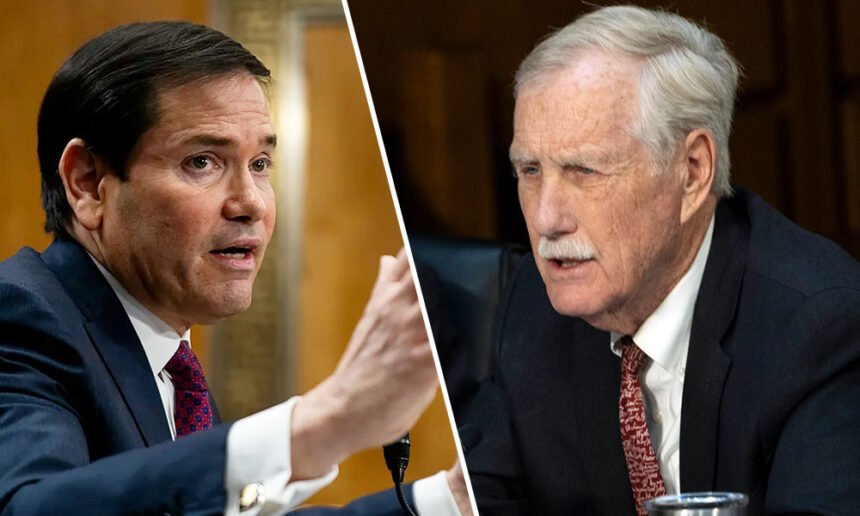
Secretary of State Marco Rubio is facing fierce backlash after offering what one senator called a “breathtaking” justification for U.S. strikes on Iran — an explanation that seemed to suggest America went to war because Israel was about to.
During a tense Senate hearing, Sen. Angus King tore into Rubio’s logic while questioning Pentagon official Elbridge Colby about the administration’s defense strategy.
King cited Rubio’s briefing to lawmakers, where the secretary reportedly said the U.S. knew Israel planned to strike Iran — and that such a strike would trigger retaliation against American forces. Therefore, the U.S. decided to launch “preemptive” attacks first.
King read Rubio’s words aloud: “We knew there was going to be an Israeli action… and if we didn’t preemptively go after them before they launched these attacks, we would suffer higher casualties.”
Then came the gut punch.
“Have we now delegated the most solemn decision that can be made in our society — the decision to go to war — to another country?” King asked. “That’s the implication, the breathtaking implication of Secretary Rubio’s statement.”
“I’d like some response on policy,” he insisted. “Is it now the policy of the United States that we’re gonna be taken into a war by the Prime Minister of another country?”
“Inadvertently Told the Truth”
King went further, suggesting Rubio may have accidentally confirmed what critics have long suspected — that Israeli Prime Minister Benjamin Netanyahu pushed aggressively for confrontation and somehow forced Trump to attack Iran.
While King reiterated his support for Israel, he made one thing clear: no ally should be steering America into war.
Colby pushed back, insisting President Donald Trump made the final call.
“Well, he made the decision,” King shot back, “but it appeared to be based upon the fact that Israel was going to strike.”
Meanwhile, Sen. Jack Reed zeroed in on another glaring issue: the administration’s own national defense strategy.
Reed pointed out that the Pentagon’s strategy — published just 39 days ago — emphasized empowering regional allies to handle Iran themselves. Yet here the U.S. was, deeply involved in direct military operations.
“Why has the department abandoned the strategy after 39 days?” Reed demanded.
Colby insisted allies were “leaning in,” but admitted the strategy wasn’t a “straightjacket.”
Translation: the plan lasted barely a month.
Reed also accused Trump of “moving the goalposts,” questioning why Iranian Supreme Leader Ayatollah Ali Khamenei was targeted if regime change wasn’t the objective.
Colby’s response? The president sets the agenda.
Trump Tries to Flip the Script
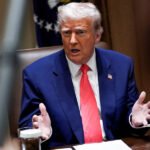
Later Tuesday, Trump denied that Israel forced his hand.
“No, I might have forced their hand,” Trump said during a meeting with German Chancellor Friedrich Merz.
He claimed Iran was preparing to strike first and that negotiations were pointless.
But Rubio’s own words — as read into the record — are now fueling a political firestorm.
Because if America launched strikes simply because Israel was about to act, that raises a question far bigger than partisan politics: Who exactly decided the United States should go to war?
Watch the video below: