




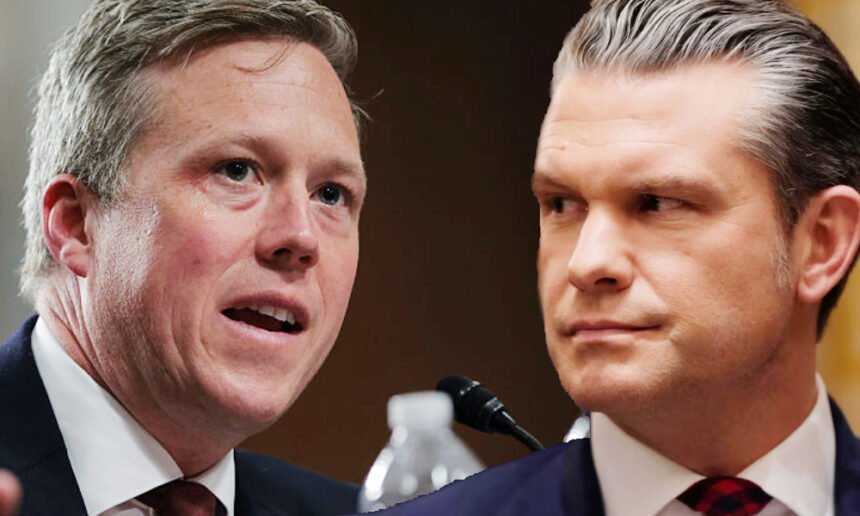
The Trump administration is losing another top military official — and this time, the departure comes amid reports of months of tension between Army Secretary Dan Driscoll and Defense Secretary Pete Hegseth.
Driscoll resigned Monday after roughly 18 months on the job, according to the White House.
No official reason was given for his departure.
But the timing is hard to ignore.
Reuters and CNN reported that Driscoll and Hegseth had endured months of tension during their time working together, adding another layer of turmoil to an administration already dealing with a major military operation in Iran.
A U.S. Army official, speaking anonymously because they were not authorized to comment publicly, said Driscoll spoke with President Donald Trump about the current state of the Army before submitting his resignation.
The official provided no further details.
The Pentagon referred questions to the Army.
Driscoll’s resignation was first reported Monday by The Wall Street Journal.
The White House, meanwhile, offered an entirely different picture of his tenure.
“Secretary Driscoll has been highly effective in advancing President Trump’s agenda to Make America Strong Again at the Department of the Army,” White House spokeswoman Anna Kelly said, praising his leadership during military operations, efforts to improve readiness and lethality, negotiations involving Russia and Ukraine, and other initiatives.
“The United States Army is more powerful than ever thanks to his work alongside the Commander-in-Chief and Secretary of War,” she added.
But Driscoll’s exit comes against a backdrop of extraordinary turnover at the top of the Army.
Hegseth abruptly removed the Army’s top uniformed officer, Gen. Randy George, in April.
Then, in June, Gen. Christopher Donahue, who commanded U.S. Army forces in Europe and Africa, unexpectedly stepped down.
Now Driscoll is gone.
That makes three major departures involving senior Army leadership in just a few months.
And Driscoll’s exit carries particular significance because he had been closely associated with George.
After George’s removal, Driscoll told Congress that he and his family drove to the general’s home and **“we all gave him a hug.”**
But Driscoll also acknowledged the reality of civilian control over the military.
“That being said, the civilian leadership, the design of our system, is that they get to pick the leaders that they want,” he told lawmakers.
George’s replacement, Gen. Christopher LaNeve, has quickly risen under Hegseth.
And some of the Army’s priorities have shifted along with the leadership.
Under LaNeve, the Army has moved to shut down a drone modernization effort that Driscoll had championed.
An Army unit in Europe had been developing its own drones, but LaNeve later directed the unit to abandon that effort and return to its traditional role as an infantry battalion, according to officials.
That change reflects a broader debate inside the military over how quickly the Army should adapt to the rapidly changing nature of warfare.
Driscoll had made modernization — particularly drones and counter-drone technology — a major focus of his tenure.
Now he’s leaving as those priorities face changes under new leadership.
Driscoll’s path to the Pentagon was unusual.
An Iraq War veteran, technology investor and former adviser to Vice President JD Vance, he met Vance at Yale Law School.
When Trump nominated him in 2024, the president described Driscoll as “a disruptor and change agent.”
The Senate confirmed him in February 2025 by a vote of 66-28.
His confirmation hearing before the Senate Armed Services Committee was largely uneventful, focusing on Army modernization, recruiting and strengthening the military industrial base.
Driscoll had also emphasized his family’s military history. His father and grandfather served in the Army, and he pledged to focus on the needs of soldiers.
He previously served as an Army armor officer from August 2007 through March 2011, including a deployment to Iraq from October 2009 through July 2010.
Before entering the Pentagon, Driscoll also ran unsuccessfully in the 2020 Republican primary for a North Carolina congressional seat, receiving about 8% of the vote in a crowded field.
Driscoll wasn’t limited to the traditional responsibilities of an Army secretary.
The administration also tapped him for an unusual role as a key negotiator in efforts to end the Russia-Ukraine war.
He also pushed for cutting through Pentagon bureaucracy so military contractors could develop drones and counter-drone technology more quickly.
That effort reflected a growing recognition inside the military that the battlefield is changing rapidly, with relatively inexpensive drones playing an increasingly important role.
Now the person who had been pushing those initiatives is out.
And his departure comes as Hegseth continues reshaping the senior ranks of the U.S. military.
The Navy has also experienced a major leadership shake-up under Hegseth, who has removed several senior generals and admirals.
The administration says the changes are part of its effort to reshape the military around Trump’s priorities.
But with another senior military official now gone — amid reported tensions with Hegseth and an increasingly unsettled leadership structure at the Army — questions about the pace and direction of those changes are unlikely to disappear.
Driscoll lasted about 18 months.