



Senate Republicans just made it easier for Donald Trump to take military action in Venezuela—without ever having to ask Congress for permission.
In a narrow 49–51 vote Thursday, GOP senators blocked a war powers resolution that would have required Trump’s administration to seek congressional authorization before carrying out strikes inside Venezuela. The measure, introduced by Sen. Tim Kaine (D-Va.), was designed to prevent exactly the kind of unilateral military move the White House now appears poised to make. Only two Republicans—Lisa Murkowski of Alaska and Rand Paul of Kentucky—broke ranks and sided with Democrats.
Kaine’s proposal was straightforward: it would have “directed the President to terminate the use of United States Armed Forces for hostilities within or against Venezuela, unless explicitly authorized by a declaration of war or specific authorization for use of military force.”
“We should not be in war without Congress,” Kaine said on the Senate floor before the vote, according to The Guardian.
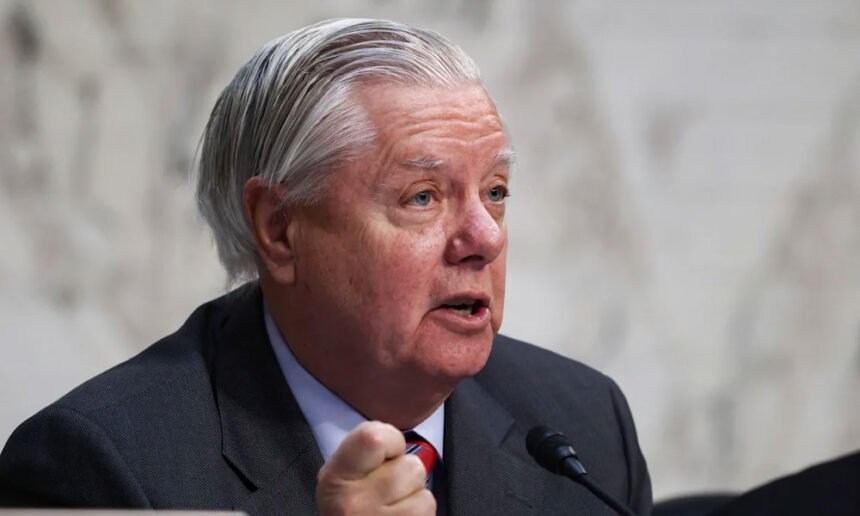
But many Republicans argued otherwise. Sen. Lindsey Graham (R-S.C.)—one of Trump’s most vocal allies—called the War Powers Act a “constitutional infringement” that strips the president of his authority to act as commander in chief.
“If you can terminate a commander in chief’s decision through the War Powers Act, then that constitutional authority has been taken by Congress and that would be a disaster for this country,” Graham said Thursday.
Democrats pushed back, warning that the administration appears to be inching toward another undeclared war. “I do not believe Americans want to ‘topple’ the Venezuelan regime in hopes that something better might follow,” said Rep. Adam Schiff (D-Calif.). “If the administration feels differently, let them come to the Congress and make the case. Let them come before the American people and make the case. Let them seek an authorization to use force to get rid of [Venezuelan leader Nicolás] Maduro. But let us not abdicate our responsibility.”
Kaine introduced the measure in mid-October, shortly after Trump publicly confirmed that he had authorized the CIA to conduct covert operations in Venezuela. The U.S. military buildup since then has been impossible to ignore—warships, fighter jets, spy planes, and even a nuclear-powered submarine now patrol the waters around South America under the U.S. Southern Command.
Despite voting against Kaine’s resolution, Sen. Todd Young (R-Ind.) admitted his vote shouldn’t be mistaken for an endorsement of Trump’s strategy. “As a matter of policy, I am troubled by many aspects and assumptions of this operation and believe it is at odds with the majority of Americans who want the U.S. military less entangled in international conflicts,” Young said after the vote. He added, “No one has declared war on Venezuela, [and] the creeping expansion of executive war-making—under presidents of both parties—without congressional input or oversight is dangerous.”
The Trump administration has already carried out 16 strikes against alleged drug-smuggling vessels in the Caribbean and Eastern Pacific, killing at least 66 people the White House labeled “narco-terrorists.” Two others were later repatriated to Ecuador and Colombia.
Despite those numbers, the administration insists it doesn’t need congressional authorization to continue the operations, arguing they don’t amount to “hostilities” under the War Powers Resolution. Officials claim the strikes are conducted “largely by unmanned aerial vehicles launched from naval vessels in international waters.”
That argument conveniently sidesteps the War Powers Resolution of 1973, which requires a president to end unauthorized military operations—or obtain congressional approval—after 60 days. That 60-day mark came and went Monday, yet the strikes continue.
Behind closed doors, lawmakers have been briefed by the administration, with Secretary of State Marco Rubio and Defense Secretary Pete Hegseth leading the most recent session Wednesday. But those meetings haven’t eased concerns among Democrats, who say key details about targeting and civilian safety remain unclear.
“What happens when there’s somebody nearby who may be innocent?” asked Rep. Jim Himes (D-Conn.), the top Democrat on the House Intelligence Committee. “We still haven’t gotten into that level of granularity. So again, I’m not too worried that they’re going to take out a fishing boat, because our intelligence community is very, very good, but I’m not confident that we know precisely who are in those boats and why they’re there.”
“Are they U.S. persons, etc,” he added. “So that’s a level of fidelity we have.”
With Thursday’s vote, Senate Republicans effectively gave Trump a free hand to decide when and where to strike next. And for a president who has shown a willingness to use force, that’s a dangerous kind of freedom.