





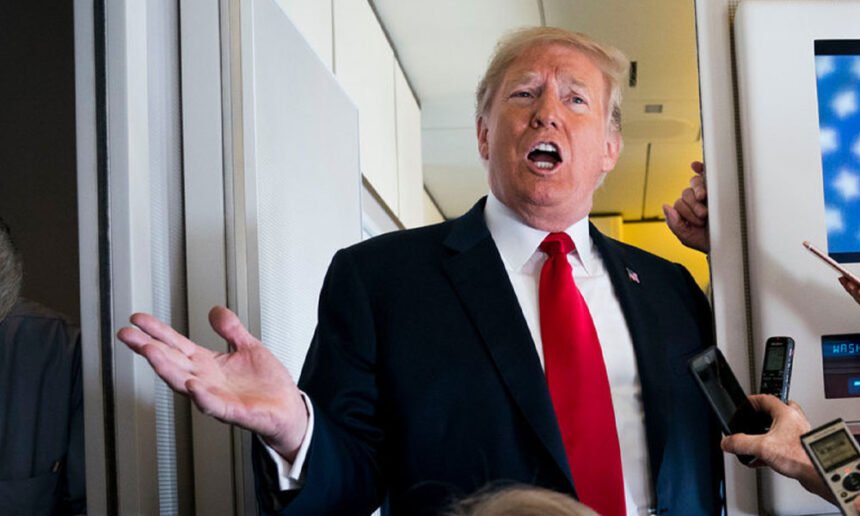
President Donald Trump stunned reporters aboard Air Force One Sunday night with an off-the-cuff remark that critics say undercuts the very rationale his administration has used to justify the escalating war with Iran.
After weeks of defending the conflict as necessary to stop Iran’s missile program and prevent it from developing nuclear weapons, Trump acknowledged there may be an argument that the United States shouldn’t even be involved in the region at all.
“You could make the case that maybe we shouldn’t even be there at all,” Trump told reporters during the flight back to Washington. “Because we don’t need the oil. We have a lot of oil. We are the number-one producer anywhere in the world.”
The remark quickly set off a wave of criticism from journalists and political observers who pointed out the contradiction: if the United States doesn’t need Middle Eastern oil and could arguably avoid the conflict altogether, why launch a costly war in the first place?
The comments come as the financial and human costs of the conflict continue to mount.
Early estimates suggest the opening days of the U.S. campaign consumed billions of dollars in precision munitions and military operations, with one analysis estimating the war cost roughly $3.7 billion in its first 100 hours alone.
Other reports suggest the cost surged to more than $11 billion within the first week, as the Pentagon burned through expensive weapons systems and deployed additional military assets across the region.
The conflict has also claimed American lives. At least 13 U.S. service members have been killed so far, while the broader regional fighting has killed more than 1,300 people in Iran and displaced millions, according to multiple reports.
Defense analysts warn that if the war continues to escalate, the long-term costs could run into the hundreds of billions of dollars, similar to previous U.S. conflicts in the Middle East.
Trump’s Shifting Justifications
Since launching the campaign earlier this year, Trump has offered multiple explanations for the war. At various points, he has claimed the strikes were intended to:
• destroy Iran’s missile infrastructure
• prevent Tehran from developing nuclear weapons
• defend U.S. allies in the region
• secure critical shipping lanes such as the Strait of Hormuz, a key route for global oil supplies.
Yet Trump’s own remarks seemed to contradict those goals.
Just hours before his latest comments, Trump suggested other countries should shoulder the burden of protecting the Strait of Hormuz, noting that nations like China depend far more heavily on Middle Eastern oil than the United States does.
That logic has fueled criticism from analysts who argue the administration’s stated objectives have shifted repeatedly as the war has expanded.
Behind the scenes, speculation is growing that Trump may be quietly searching for an exit ramp from the conflict.
Rising oil prices, growing international pressure, and mounting military costs have intensified scrutiny of the war inside Washington and among U.S. allies. The closure of key shipping routes in the Persian Gulf has already sent global energy markets into turmoil. ([The Guardian][3])
But ending the war may not be simple.
Iran has vowed to continue fighting following the initial U.S. strikes and has launched missile and drone attacks across the region in response.
That leaves Trump facing an increasingly difficult political reality: a war he started, with unclear objectives, rising casualties, and costs that continue climbing by the day.
And now, critics say, even the president himself seems unsure why the United States is there at all.
Watch the clip below:
Trump: You could make the case that maybe we shouldn’t even be there at all pic.twitter.com/eksmDTpT3Y
— Acyn (@Acyn) March 16, 2026