



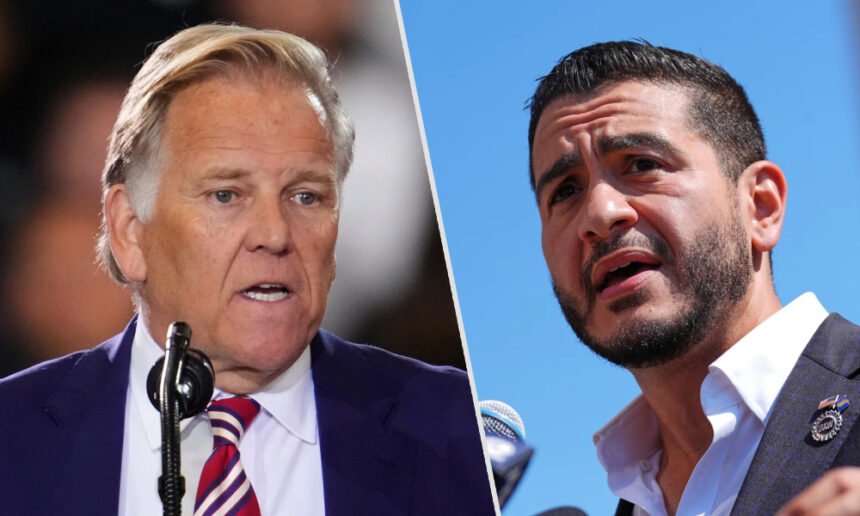
Mike Rogers has spent recent weeks trying to turn 9/11 into a political weapon against his Democratic opponent, Abdul El-Sayed.
The Michigan Republican Senate candidate has attacked El-Sayed over old comments about the terrorist attacks and has falsely suggested that El-Sayed said the United States deserved 9/11. But while Rogers tries to put his opponent on trial over a claim he falsely attributed to him, his own congressional record is now coming under scrutiny.
Rogers voted twice against the James Zadroga 9/11 Health and Compensation Act in 2010, legislation that provided healthcare and other benefits to first responders and survivors of the attacks. He also supported or opposed other measures affecting federal assistance for first responders during his time in Congress.
That record is especially striking given how prominently Rogers has made his national-security credentials—and 9/11—part of his campaign against El-Sayed.
The Zadroga legislation was designed to provide medical care and compensation for people who became sick after working in the toxic environment around Ground Zero and other 9/11 attack sites.
Rogers was among the Republicans who voted against the legislation. The congressional record shows him voting “nay” on two House votes involving the bill.
At the time, Rogers argued that the legislation raised serious concerns about the cost to the federal government. According to 9/11 first responder advocate John Feal, Rogers personally questioned where the money to treat sick responders would come from.
Feal, who spent 11 weeks in the hospital after a steel beam fell on his foot at Ground Zero and ultimately lost part of his foot, said he personally discussed the legislation with Rogers while advocating for the bill.
Feal told the Guardian that Rogers characterized the health problems facing first responders as a “New York problem” and asked where the money to help them would come from.
Feal described Rogers’ opposition as “a betrayal.”
“Here’s the thing: Republicans like Mike Rogers love cops and firefighters until one gets shot or burned in a fire and can’t do his job,” Feal said.
The Rogers campaign did not respond to the Guardian’s requests for comment.
And the Zadroga votes were not the only time Rogers’ congressional record intersected with funding for first responders.
In 2002, Rogers voted against additional funding for veterans’ healthcare and first responders included in legislation compensating New York City schools for expenses related to 9/11.
In 2011, he voted for a homeland security appropriations bill that included significant cuts to funding for state and local first responders and terrorism-prevention programs.
In 2013 and 2014, Rogers voted against amendments to budget legislation that included billions of dollars in funding for first responders. He also voted against a 2013 proposal involving protections for first responders’ pensions.
Now, nearly 25 years after the attacks, Rogers is once again putting 9/11 at the center of a political fight.
His target is El-Sayed, a Muslim Democrat whose old comments about the attacks have become a major focus of the Republican campaign.
But Rogers’ attacks have included claims about El-Sayed that are not supported by the record.
El-Sayed has repeatedly condemned the 9/11 attacks. In a 2021 recollection of the day, he wrote that he watched terrorists “with names like mine” attack his country in the name of his faith and described the deaths of nearly 3,000 Americans.
The comments Rogers has sought to associate with El-Sayed were actually made by Hasan Piker, an online political commentator.
Then Rogers added another extraordinary claim to the 9/11-related campaign messaging.
In a fundraising email, Rogers wrote: “I saw the dead body of Osama bin Laden with my own eyes, knowing that together, we had delivered justice for America.”
The problem is that Rogers was not in Pakistan when U.S. forces killed bin Laden in May 2011. He was also not in the White House Situation Room during the raid.
Rogers was serving as chairman of the House Intelligence Committee and was in Washington. He was informed about the operation by CIA Director Leon Panetta and later saw a photograph of bin Laden’s body.
In other words, Rogers did have access to information about the raid and ultimately saw photographic evidence of bin Laden’s death—but he did not personally see bin Laden’s body at the site of the raid, as his fundraising language might suggest.
The 9/11 fight has also drawn criticism from Michigan firefighter Henry Yanez, a retired firefighter and Sterling Heights city council member who has endorsed El-Sayed.
Yanez was among firefighters who traveled to New York after the attacks to support local fire departments.
He criticized Rogers’ record on first responders.
“When you’re talking about the health and safety of our first responders, and now you’re going to kick the can down the road, you know—that’s a problem as far as I’m concerned,” Yanez said. “Mike Rogers—shame on him.”
Yanez said Rogers’ background makes the votes particularly surprising, given that Rogers previously worked as an FBI agent.
“He should get it,” Yanez said.
For Feal, the issue is even more personal.
He believes Rogers’ record on first responder legislation should matter as much as anything the Republican is saying about 9/11 on the campaign trail.
“Many members of Congress think they’re untouchable until they get humbled and get beat in an election,” Feal said.
“Rogers is not invincible, and he’s just in this for himself.”
And that creates an uncomfortable contrast for Rogers. He is asking Michigan voters to scrutinize Abdul El-Sayed’s words about 9/11 while his own congressional record includes two votes against legislation providing healthcare and benefits to people who became sick after responding to the attacks.