








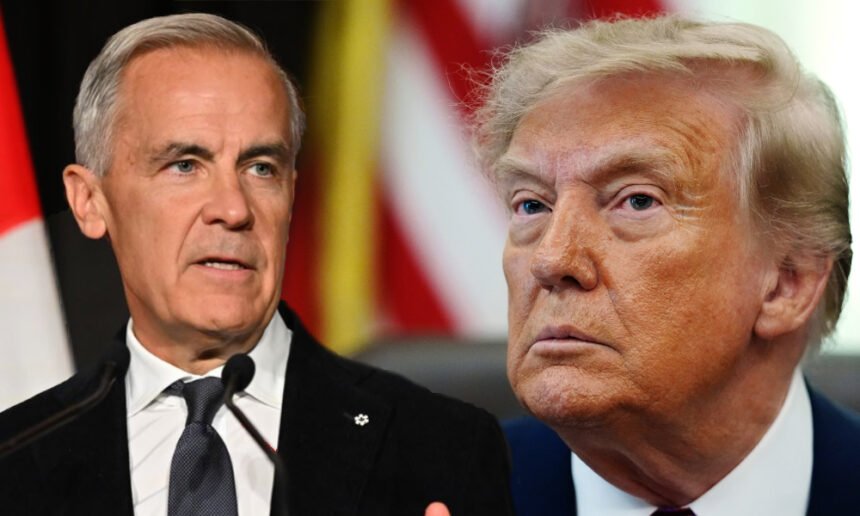
Canadian Prime Minister Mark Carney had a message for President Donald Trump on Thursday: Canada will decide for itself who it partners with.
Speaking before the European Parliament in Strasbourg, Carney embraced a proposal for much deeper ties between Canada and the European Union — just hours after Trump threatened retaliation if the bloc moves forward with plans to make Canada its first “associate member.”
“Nobody is going to dictate” to Canada who it can make international agreements with, Carney said.
The blunt response came after Trump dismissed the EU proposal as “laughable” and warned that he could hit Europe with “very serious tariffs” or even stop trading with the bloc on certain goods if he considered the move a hostile act.
“If it’s a good intention, that’s fine,” Trump said. “If it’s a bad intention, we’ll put very heavy tariffs on Europe.”
Carney, however, showed no sign of backing away.
“Europe and Canada are each strong. Europe and Canada are even stronger together,” he told lawmakers.
He said Canada and Europe should deepen cooperation in critical minerals, defense, artificial intelligence and computing, energy security, space, payments and digital trade.
“The objective is not self-sufficiency. It is collective resilience,” Carney said.
He also made clear that Canada is not trying to create another geopolitical bloc designed to challenge the United States or China.
“I am not proposing a third bloc in order to become a great-power rival — only with better manners,” Carney said. “We do not seek power to dominate others.”
Instead, he argued that Canada and Europe should work together to make themselves less vulnerable to pressure from any single country.
“We are not fair-weather allies,” Carney said. “We believe that our prosperity grows when it is shared.”
The remarks came one day after European Commission President Ursula von der Leyen proposed making Canada the EU’s first “associate member,” a concept that does not currently exist as a formal EU status and whose details have yet to be worked out.
Carney welcomed the ambition behind the proposal while emphasizing that the substance matters more than the label.
The proposed relationship could include expanded cooperation on defense, energy, critical minerals, technology and trade, along with Canadian participation in European programs such as Erasmus+ and Horizon.
The timing is hardly accidental.
Canada has been trying to reduce its economic dependence on the United States as relations with Washington have deteriorated under Trump. The EU, meanwhile, is also seeking greater strategic independence amid trade tensions with the United States and growing geopolitical pressure.
Trump’s latest threat only underscored the tension.
European Commission spokesman Olof Gill rejected the suggestion that closer ties with Canada were directed against the United States, saying the proposal was “not against anyone else, but for our common strength.”
France’s Europe minister, Benjamin Haddad, was even more direct, saying the United States has no veto over Europe’s geopolitical choices.
For Carney, the message was equally clear. Canada intends to make its own decisions.
And if Trump thought threatening Europe would make Ottawa back away from Brussels, Carney’s speech suggested the opposite.