







Donald Trump loves to talk tough. But when the moment arrives to actually back up the rhetoric, the tough guy act can disappear pretty quickly.
He spent months portraying China as one of America’s biggest adversaries. He threatened, pressured and publicly railed against Beijing.
Then Xi Jinping showed up. And suddenly, the tough guy routine disappeared.
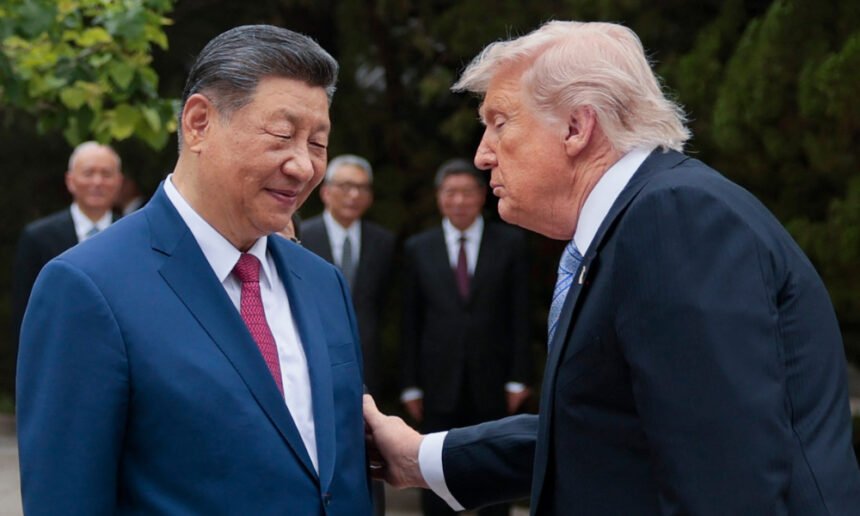
Trump greeted Xi with a 21-gun salute, a B-1 bomber flyover and a state dinner at the White House. And Trump, kicking off the two-day summit, hailed his relationship with the Chinese president as a “truly great friendship.”
So much for tough.
The timing, however, was hard for some Republicans in Congress to swallow.
Just as Trump was lavishing Xi with presidential honors, U.S. intelligence assessments were raising serious concerns about Chinese assistance that has helped Iran improve its ability to target American forces.
According to U.S. officials cited in recent reporting, Chinese satellite imagery and other intelligence support helped Iran carry out increasingly precise attacks on U.S. military positions. The intelligence was reportedly used in the July attack on a U.S. base in Jordan that killed three American service members.
That has left some Republican senators wondering why Xi was getting the royal treatment instead of a very uncomfortable conversation.
Sen. Lisa Murkowski, R-Alaska, called the military reception for Xi “over the top.”
“Is it appropriate that you welcome him? Yeah,” Murkowski said. “But it’s equally appropriate that you ask him really tough questions.”
She specifically objected to the 21-gun salute, red carpet and bomber flyover.
And she’s hardly alone.
Sen. John Cornyn, R-Texas, said he understands the importance of diplomacy but wasn’t enthusiastic about Trump inviting Russian President Vladimir Putin to the upcoming G20 summit or rolling out the red carpet for Xi.
“I understand the importance of engagement and diplomacy,” Cornyn said, “but inviting Putin to the G20 and rolling out the red carpet for President Xi, I’m not enthusiastic about that.”
Cornyn, a member of the Senate Intelligence Committee, said China, Russia, Iran and North Korea increasingly appear to be cooperating in ways that threaten U.S. interests.
His message was essentially this: Diplomacy is fine. Pretending the other side isn’t working against you is something else.
Sen. John Curtis, R-Utah, was even more direct.
He said he hoped Trump would raise China’s support for Iran with Xi and make clear that such assistance has consequences.
That matters because the concerns go beyond one satellite image.
Recent U.S. intelligence assessments described to CNN indicate Chinese groups have provided satellite imagery and other intelligence that has helped Iran improve its targeting of U.S. bases and naval forces in the Middle East.
The Wall Street Journal previously reported that Iran obtained high-resolution satellite imagery of the U.S. base in Jordan from Chinese entities before and after the July 17 attack. Three American service members were killed and four others wounded.
Sen. Kevin Cramer, R-N.D., said Trump should raise the issue directly with Xi.
“It’s fine that he’s here, and it’s fine that he treats him like a foreign leader,” Cramer said. “But it’s also important that he confronts these issues with him.”
Cramer also said Trump needs to be “really strong” with China over national security issues, including concerns about Chinese access to sensitive F-35 components.
Then there was Sen. Roger Wicker, R-Miss., chairman of the Senate Armed Services Committee.
Wicker had already criticized the elaborate reception before Xi arrived, suggesting Trump should not have invited Xi to Washington for such a lavish welcome.
He said Trump should use the state dinner to ask Xi about China’s military buildup and its reported support for Iran.
Translation: If Xi is going to sit down for steak and diplomacy at the White House, somebody might want to ask him about the part where Iran is allegedly using Chinese intelligence to make it easier to kill Americans.
Sen. Thom Tillis, R-N.C., was even less diplomatic.
“We should be having those sorts of reception for people who are not plotting our ultimate demise — not Xi Jinping,” Tillis said.
The White House, meanwhile, says Trump is simply practicing diplomacy.
White House spokesperson Anna Kelly said Trump was reciprocating the hospitality Xi showed him during Trump’s visit to China.
“The President will forge relationships with anyone in order to advance our national interests and make good deals for the American people,” Kelly said.
Trump certainly appeared committed to the relationship.
He called his friendship with Xi “truly great.”
Xi struck a more measured tone, saying the interests of China and the United States are “deeply intertwined.”
Meanwhile, American lawmakers were coming out of a classified briefing warning about Chinese assistance to Iran and its potential impact on American troops.
That’s quite a contrast.
The argument from Trump’s critics isn’t necessarily that Washington should stop talking to Beijing. Even some Republicans criticizing the summit acknowledge the importance of diplomacy and engagement.
The argument is about leverage.
If China is helping Iran improve its ability to target American forces, these senators want Trump to confront Xi about it — not simply smile for the cameras and move on to the state dinner.
And that’s where the optics of this summit get uncomfortable.
Trump once built his political brand around taking a hard line against China.
Now Xi is getting a 21-gun salute, a bomber flyover and a White House state dinner while Republican senators are publicly demanding that Trump ask some very unpleasant questions.