







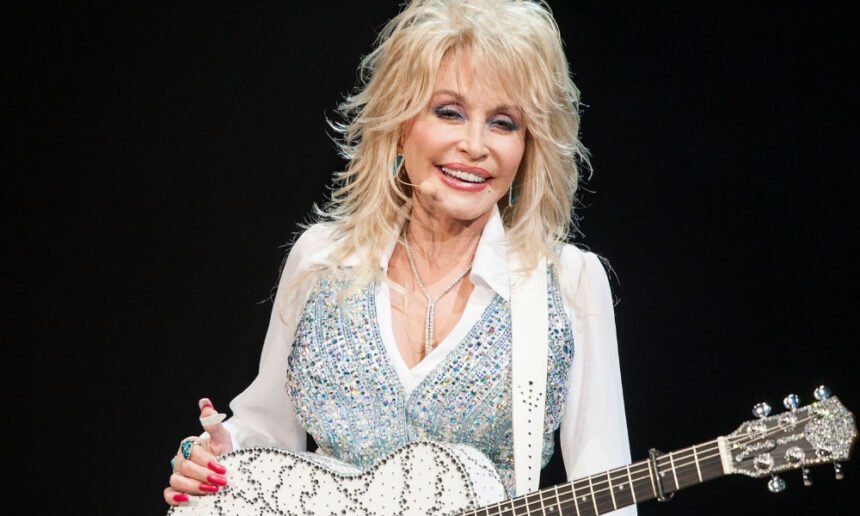
Dolly Parton, the legendary country singer-songwriter whose unmistakable voice, songwriting brilliance, Hollywood career and extraordinary philanthropy made her one of America’s most beloved entertainers, has died at 80.
Her death was announced by her nephew Brian Seaver on Instagram.
“I have imagined the heaviness of this moment but haven’t truly felt it until now,” Seaver wrote, describing her death as an “honour” mixed with “absolute pride and great sadness.”
Parton leaves behind a legacy that is almost impossible to measure.
She wrote “Jolene” and “I Will Always Love You” in the same day—two songs that would become permanent fixtures of American music. Over a career spanning more than six decades, she scored a record 25 No. 1 country singles and 47 country albums that reached the Top 10.
And she wasn’t content to stay in one lane.
Parton crossed into pop music with “9 to 5,” built a successful acting career, became a shrewd businesswoman and devoted enormous resources to helping children learn to read.
Her Imagination Library literacy program has distributed more than 150 million books to children.
And she did it all with rhinestones, towering hair, big personality and an almost unmatched ability to laugh at herself.
Her famous line about her appearance, “it takes a lot of money to look this cheap,” may have captured Parton’s humor, but it never quite captured the size of her accomplishments.
From a one-room cabin to country music royalty
Parton’s story began in poverty.
She was born in a one-room cabin in Tennessee, the fourth of 12 children. Her father worked as a farmer and construction worker, while her mother raised the enormous family.
Her upbringing became part of her songwriting.
“Coat of Many Colours,” one of her most beloved songs, was inspired by the patchwork clothing her mother made for her.
Her first guitar was cobbled together from a mandolin using bass guitar strings. An uncle eventually gave her a proper guitar when she was 8.
By 10, she was appearing on local television.
At 13, she recorded her first record and performed at Nashville’s Grand Ole Opry, where Johnny Cash introduced her.
Parton already knew where she was headed.
“I’ve always believed things would go well, and I dreamed that they would even before I was in high school,” she later said. “I always wanted to be a star. It just seemed natural to me.”
After graduating high school in 1964, she moved to Nashville.
She initially found success as a songwriter before getting the opportunity to become a recording artist herself. Her first attempts at pop music didn’t take off, but after switching to country, the hits started coming.
Her debut album, Hello, I’m Dolly, arrived in 1967.
That same year, she began her famous professional partnership with country singer and television personality Porter Wagoner.
In 1971, she scored her first country No. 1 with “Joshua.”
Then came the songs that turned Dolly Parton into a legend.
‘Jolene’ and ‘I Will Always Love You’
Released in 1973, “Jolene” was Parton at her most vulnerable—a desperate plea to another woman not to steal away the man she loved.
The song became her first major UK hit.
Then came “I Will Always Love You.”
Parton wrote the song as a farewell to Wagoner after deciding to end their professional partnership. It reached No. 1 on the country chart in 1974 and did so again after Parton rerecorded it in 1982.
Then Whitney Houston got hold of it.
Houston’s enormous 1992 version, recorded for *The Bodyguard*, transformed the song into a global phenomenon and cemented Parton’s songwriting legacy far beyond country music.
The song became one of the best-selling singles ever recorded by a female artist.
By the late 1970s, Parton was deliberately expanding beyond traditional country music.
Her 1977 album New Harvest … First Gathering marked her first appearance on the pop album chart. Its follow-up, **Here You Come Again**, became her first million-selling album.
Then came 1980.
Parton had three consecutive country No. 1s, including “9 to 5,” the title song from the hit comedy in which she starred alongside Jane Fonda and Lily Tomlin.
The song earned Parton an Oscar nomination for Best Original Song.
She would eventually turn 9 to 5 into a Broadway musical as well.
Hollywood kept calling.
She appeared opposite Burt Reynolds in The Best Little Whorehouse in Texas , Sylvester Stallone in Rhinestone and an all-star female cast in Steel Magnolias.
In music, she teamed with Kenny Rogers for “Islands in the Stream,” which topped the U.S. pop chart.
She also joined Emmylou Harris and Linda Ronstadt for the extraordinary Trio album in 1987.
The collaboration earned Parton her only Grammy nomination for Album of the Year.
She reunited with Harris and Ronstadt for Trio II in 1999, which included a Grammy-winning cover of Neil Young’s “After the Gold Rush.”
Parton never stopped recording.
She released acclaimed bluegrass albums, collaborated with younger artists and continued making music well into her later years.
Her most recent album was 2023’s Rockstar, which featured collaborations with a wide range of artists.
She also maintained a close relationship with her goddaughter, Miley Cyrus.
Then there was Dolly the philanthropist
For all of Parton’s musical accomplishments, perhaps her most enduring legacy will be what she did with her success.
In 1986, she became involved with a Tennessee theme park and renamed it Dollywood, eventually helping transform it into a major attraction and business empire.
She used that success to fund philanthropic work through the Dollywood Foundation.
The most famous of those efforts is the Imagination Library, which Parton launched in 1995.
The idea was simple: Give children books.
Every month, children received an age-appropriate book in the mail.
Parton’s motivation was personal.
Her father couldn’t read or write, and she understood how profoundly that could limit a person’s opportunities.
The program eventually expanded beyond her native Tennessee, first across the United States and then internationally.
Today, millions of children receive books through the program each year.
In 2022, Amazon founder Jeff Bezos donated $100 million to Parton’s charitable efforts.
Parton explained that the program wasn’t only about literacy.
It was also about making children feel valued.
“They get this little book with their little name on it in the mail,” she said. “They feel special.”
That philosophy defined much of Parton’s philanthropy.
She helped preserve the bald eagle, contributed $500,000 toward a hospital in her home county, supported victims of the devastating 2016 Smoky Mountain wildfires and contributed to HIV/AIDS-related charitable efforts.
She supported Black Lives Matter and transgender rights and opposed North Carolina’s controversial “bathroom bill.”
She also donated $1 million to Vanderbilt University Medical Center in 2020 to support COVID-19 research.
That money helped fund research that contributed to the development of Moderna’s COVID-19 vaccine.
A final chapter
Parton’s personal life was remarkably private compared with her enormous public profile.
She married Carl Dean in 1966, and the couple remained together for nearly six decades. They renewed their vows in 2016 to celebrate their 50th anniversary.
Dean died in 2025.
In May 2026, Parton canceled her Las Vegas residency because of health issues.
A Broadway musical based on her life and music was also scheduled to open later this year following a Nashville run.
Now, the woman who grew up in a one-room Tennessee cabin and became one of the biggest stars in American entertainment is gone.
But Dolly Parton’s songs will remain.
So will the movies.
The theme park.
The books.
The children who learned to read because she decided that success meant more if it could be shared.
Parton once said she always believed things would go well.
For more than six decades, she made sure they did—for herself, and for millions of other people along the way.