








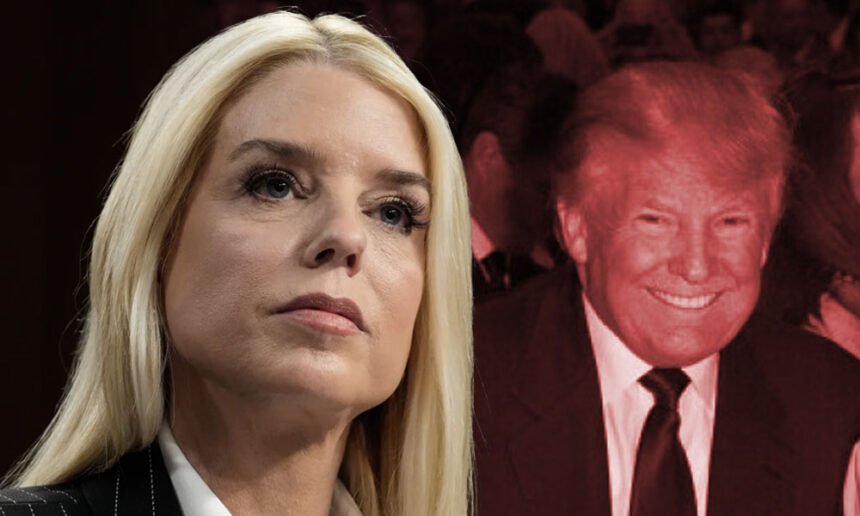
Just as Attorney General Pam Bondi struggles to answer questions about the Justice Department’s handling of the Jeffrey Epstein files, a decade‑old scandal involving a $25,000 “donation” from Donald Trump’s foundation has roared back into public view — and critics are calling it newly relevant amid the current controversy.
In 2013, while Bondi was Florida’s attorney general, she personally solicited a $25,000 contribution from the Donald J. Trump Foundation to support her political campaign committee, And Justice for All — a move that later drew scrutiny for its timing and legality. As noted by the watchdog group Citizens for Responsibility and Ethics in Washington (CREW), private charitable foundations like Trump’s are prohibited from making political contributions, and the Trump Foundation initially failed to report the gift correctly on its tax filings.
According to CREW, the donation arrived only days after it was reported that Bondi’s office was considering whether to join a lawsuit in New York against Trump University over widespread allegations of fraud and deceptive practices. Shortly after the money was received, Bondi’s office declined to join the investigation, drawing accusations of a potential quid pro quo.
Records later showed that before receiving the contribution, Bondi’s attorneys general office had received at least 22 complaints about Trump University and related entities dating back to 2008, though internal communications later downplayed the volume of complaints.
The watchdog group aggressively pursued the matter. In March 2016, CREW filed a formal complaint with the IRS asserting that the Trump Foundation had illegally donated to a political campaign committee at a time when Bondi’s office was considering legal action against Trump’s business interests. CREW also flagged the foundation’s failure to accurately report the contribution on its tax forms.
Bondi defended herself at the time, claiming her office was not investigating Trump University and that she was not lying or taking the money in exchange for official action. Her office maintained it was unaware of the full scope of complaints about Trump’s business school when she solicited the contribution.
Despite the legal prohibitions on political contributions from charities, the Trump Foundation paid only a token IRS penalty — a $2,500 fine — for the violation, and no penalties were levied against Bondi herself. The foundation also attempted to correct its filings by retroactively listing a similarly named Kansas charity it claimed was the intended recipient, even though no such donation ever occurred.
CREW’s concerns didn’t stop there. The group filed additional complaints with the Department of Justice and the Florida Commission on Ethics, arguing that both Trump and Bondi might have violated federal anti‑bribery laws and state ethics rules by engaging in conduct that appeared designed to influence official decisions.
Now, as Bondi defends her stewardship of the Epstein files — a role that has drawn bipartisan criticism for evasive testimony and redactions — opponents are pointing back to the Trump Foundation controversy as evidence of a longstanding pattern of controversial, ethically questionable decisions.
The resurfacing of this scandal, once a flashpoint during the 2016 election cycle, adds fuel to the fire surrounding Bondi’s current tenure as Attorney General, raising fresh questions about her judgment, independence, and ties to Trump’s political and legal interests.