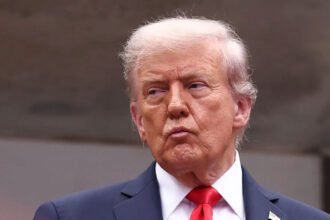







A federal appeals court has delivered a decisive setback to President Donald Trump, rejecting his bid to revive a defamation lawsuit against CNN over the network’s use of the phrase “Big Lie” to describe his false claims of election fraud in 2020.
The three-judge panel, which included two of Trump’s own appointees, ruled Tuesday that CNN’s use of the term—historically associated with Adolf Hitler—fell squarely under First Amendment-protected opinion.
“Trump’s argument hinges on the fact that his own interpretation of his conduct — i.e., that he was exercising a constitutional right to identify his concerns with the integrity of elections — is true and that CNN’s interpretation — i.e., that Trump was peddling his ‘Big Lie’ — is false,” the unanimous 11th Circuit Court of Appeals panel concluded. “However, his conduct is susceptible to multiple subjective interpretations, including CNN’s.”
The ruling makes clear that CNN’s characterization cannot form the basis of a defamation claim because it is not a factual assertion.
“CNN’s subjective assessment of Trump’s conduct is not readily capable of being proven true or False,” wrote Obama appointee Adalberto Jordan, joined by Trump appointees Kevin Newsom and Elizabeth Branch.
Trump now has the option to ask the full 11th Circuit to rehear the case or to appeal to the Supreme Court. A spokesperson for his legal team signaled that the president would continue pursuing the fight, saying he “will pursue this case against CNN to its just and deserved conclusion.”
Tuesday’s ruling upholds a July decision by Florida-based U.S. District Judge Raag Singhal, also a Trump appointee, who dismissed Trump’s $475 million lawsuit against the network. That suit, filed in 2022 by Trump’s then-personal attorney Lindsey Halligan, claimed the term “Big Lie” was meant to evoke Nazi comparisons. Singhal ruled that opinions, even ones that are objectionable, do not constitute defamation unless they also assert false facts. The appeals court agreed.
“Trump’s argument is unpersuasive,” the panel wrote. “Although he concedes that CNN’s use of the term ‘Big Lie’ is, to some extent, ambiguous, he assumes that it is unambiguous enough to constitute a statement of fact. This assumption is untenable.”
The decision represents another legal blow to Trump’s ongoing effort to target mainstream media. His lawsuits have ranged from TV networks to the New York Times, with mixed results: significant settlements with ABC and CBS’s parent companies, but repeated setbacks in cases against the Times and CNN. Trump has most recently threatened to sue the BBC over its edit of his January 6, 2021, speech on the Ellipse before the Capitol attack.