








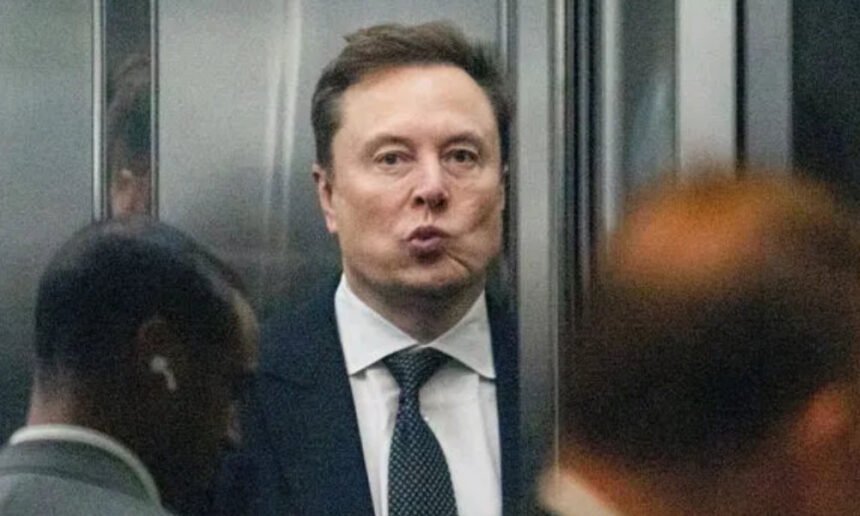
Elon Musk is facing growing backlash from Republicans who are increasingly worried that one billionaire and his space company have too much control over America’s national security, and Ukraine’s ability to fight a war.
The latest controversy erupted after Ukraine lost access to Starshield, SpaceX’s military-oriented satellite communications system. The restrictions have sparked calls for investigations, raised questions about who made the decision, and fueled concerns that Musk’s control over critical technology gives him extraordinary influence over U.S. foreign policy and military operations.
Now, according to The Hill, even Republicans who have supported the Trump administration are warning that America’s reliance on Musk’s company could become a serious national security problem.
Sen. Kevin Cramer (R-N.D.), a member of the Senate Armed Services Committee, said Thursday that he was concerned the United States had become too dependent on SpaceX, which operates Starlink and its military-focused counterpart, Starshield.
After receiving a classified briefing on Ukraine’s loss of access, Cramer warned that the country was putting too many of its space capabilities in the hands of a single company.
“We’re putting too many eggs in one company’s basket when it comes to our space assets,” he said.
Cramer said he planned to press Republican leadership to invest more resources in competition for satellite manufacturing and launches. His concern is that SpaceX’s dominance could leave the United States dangerously vulnerable if the company’s services were restricted, disrupted, or made unavailable when they were needed most.
He also questioned how much power Musk — one private individual — should have over America’s ability to operate in space, which has become an increasingly important military domain.
A Republican Senate aide echoed those concerns, describing SpaceX’s dominance as a growing problem.
The backlash goes beyond concerns about market competition. Lawmakers want to know who made the decision to restrict Ukraine’s access to Starshield and whether senior U.S. officials played a role.
Secretary of State Marco Rubio and Defense Secretary Pete Hegseth appeared Wednesday to point toward the commercial nature of the arrangement. Rubio said Ukraine’s access was governed by a private contract that determines how the technology can be used and what speeds are permitted.
But critics argue that when a private company’s technology becomes essential to military operations, decisions about access can have consequences far beyond an ordinary business dispute.
Republican Rep. Mike Turner of Ohio, the former chairman of the House Intelligence Committee, called for an investigation over the weekend.
“There needs to be an investigation, we need to find out who these people are because lives are at risk and lives are lost over these things,” Turner told CBS News’ *Face the Nation*.
Four Republican senators — John Cornyn of Texas, Thom Tillis of North Carolina, Susan Collins of Maine, and Lisa Murkowski of Alaska — also joined a bipartisan letter asking the Defense Department’s inspector general to investigate whether senior Pentagon officials had any role in limiting Ukraine’s access to Starlink or Starshield.
Republican Rep. Brian Fitzpatrick of Pennsylvania went further after *The Wall Street Journal* reported that Musk personally ordered the slowdown of Ukraine’s access to Starshield.
“We got to call the witnesses, got to bring them in, put them under oath, and get to the bottom of it,” Fitzpatrick said Tuesday. He called the matter serious because of the potential consequences for human life and said there must be accountability if the restrictions caused deaths.
The investigation could help establish who made the decision, what authority they exercised, and what consequences followed.
The controversy is exposing a broader vulnerability: America’s growing dependence on SpaceX for critical space infrastructure.
Musk’s influence became particularly visible in March 2025, when NASA relied on a SpaceX Dragon capsule to bring astronauts Suni Williams and Butch Wilmore home after they spent 286 days aboard the International Space Station. Their return followed problems with Boeing’s Starliner spacecraft, which had originally been scheduled to bring them back.
That episode highlighted America space program’s reliance on SpaceX. The Ukraine controversy is now raising a different question: What happens when a company that provides critical infrastructure can also make decisions that affect a nation’s military operations?
SpaceX faces competition from established aerospace contractors such as Boeing and newer players such as Jeff Bezos’s Blue Origin. But Blue Origin is still trying to catch up in heavy-lift launch capabilities, leaving SpaceX with a commanding position in parts of the commercial space industry.
For lawmakers concerned about national security, the issue is not simply whether SpaceX is successful. It is whether the United States has enough alternatives if its services become unavailable or a company’s decisions conflict with government priorities.
The controversy is also causing unease among U.S. allies.
Polish Foreign Minister Radoslaw Sikorski warned Musk that European governments were watching how he handled access to technology used for critical communications.
“Hey, @elonmusk, big man, are you playing politics with your products again? As your European customers, we are watching you,” Sikorski wrote on X, the social media platform Musk owns.
His warning reflects a broader concern among NATO allies: Can governments safely build their defense communications networks around technology controlled by a private billionaire whose decisions may change?
Ross Gerber, an investor in SpaceX, also criticized the restrictions in an interview with CNN. He argued that the episode had given potential customers a reason to question whether Starlink could be relied upon for national security purposes.
The dispute could have implications for future contracts and the willingness of allied governments to depend on SpaceX for battlefield communications.
Democrats have also demanded answers. Sen. Elizabeth Warren of Massachusetts, who serves on the Senate Armed Services Committee, called for an investigation into who ordered the restrictions.
Warren warned that the United States would face an “enormous risk” if Musk were effectively dictating foreign policy by controlling Ukraine’s access to technology used in military operations.
“We’d like to know exactly who is responsible for what happened,” Warren told CNN. “If it is one man, Elon Musk, who is dictating our foreign policy, then he puts the United States at enormous risk.”
This is not the first time Musk’s role in Ukraine’s military operations has drawn scrutiny. Warren called for an investigation two years ago after reports that Musk had restricted Starlink access during a Ukrainian operation targeting Russia’s naval fleet in the Black Sea.
Now, with Republicans joining Democrats in demanding answers, the pressure could extend beyond the immediate Ukraine dispute to Musk’s broader network of federal contracts.
A Republican aide predicted that if Democrats gain control of the House — and possibly the Senate — in next month’s election, they will push aggressively to rein in Musk’s federal business.
“Musk is in for a rude awakening,” the aide warned.
The growing bipartisan scrutiny suggests lawmakers are no longer treating those questions as an abstract concern about corporate power. They are demanding answers about a technology that has become central to modern warfare, and about who ultimately controls it.