





An Air Force major who publicly called for Donald Trump’s impeachment is being held in solitary confinement around the clock while facing a possible court-martial, according to his attorney.
Maj. Jason Watson has been in pretrial confinement since August, after publicly criticizing Trump and his administration. His case has sparked a legal battle over the military’s ability to punish an officer for speaking out against the commander in chief.
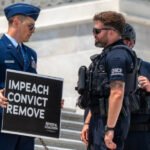
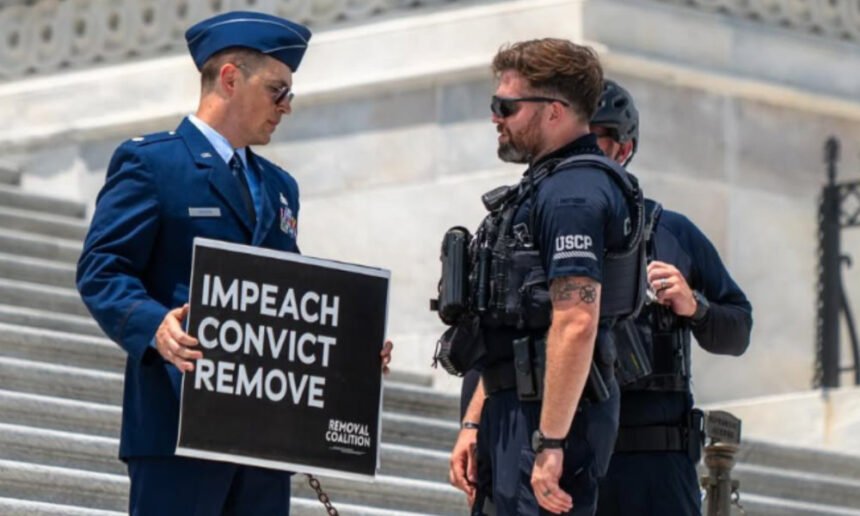
Watson was arrested July 1 on the steps of the U.S. Capitol, where he demonstrated in uniform with a sign reading “Impeach. Convict. Remove.” He had also spoken at a news conference calling for Trump’s removal from office.
Then, on Aug. 17, Watson reiterated his criticism in an interview with CNN. The following day, the Air Force ordered him into pretrial confinement at a county facility in Maryland.
More than a month later, his attorney says Watson remains isolated around the clock.
“He’s still in solitary confinement 24 hours a day,” attorney Christopher Mutimer told CNN on Oct. 9, according to Military.com.
“Even if he gets an hour to eat or to exercise, he’s alone,” Mutimer added.
Watson now faces the possibility of being kicked out of the military, losing his benefits and spending significant time behind bars.
“He is looking at having his liberty potentially taken away,” Mutimer said.
The Air Force and Mutimer did not respond to Military.com’s requests for comment on Watson’s confinement conditions. The service has not publicly addressed the attorney’s description of the isolation.
The circumstances of Watson’s confinement raise questions because military law explicitly prohibits using pretrial detention as a form of punishment.
Article 13 of the Uniform Code of Military Justice bars punishment before trial and states that confinement cannot be “any more rigorous than the circumstances require.”
That distinction matters. Watson has not been convicted of the charges against him and remains presumed innocent while the case proceeds.
When the Air Force initially ordered his confinement in August, it cited “probable cause to support allegations of continued misconduct.” Officials also said Watson was presumed innocent and would receive the rights guaranteed under military law, including a review of his confinement.
If a military judge ultimately determines that pretrial detention crossed the line into punishment, Watson could receive credit against any eventual sentence.
But the Air Force has not publicly explained why Watson is reportedly being held in isolation around the clock or addressed his attorney’s account of the conditions.
Watson faces charges under three articles of the Uniform Code of Military Justice, including Article 88, a rarely used provision that prohibits commissioned officers from using “contemptuous words” against the president and certain other civilian officials.
Prosecutors are pursuing a general court-martial, the military’s most serious trial forum, comparable in important respects to a civilian felony proceeding.
In September, a hearing officer recommended that most of the charges proceed to a general court-martial while recommending that several others be dismissed, according to Military.com.
However, the Air Force has not publicly confirmed that the commander with authority over the case has formally referred it to trial.
Watson’s defense team wants the case handled instead through a special court-martial, a less severe forum.
His attorney has also drawn comparisons to Marine Lt. Col. Stuart Scheller, who was court-martialed after publicly criticizing military leaders over the chaotic U.S. withdrawal from Afghanistan. Scheller ultimately pleaded guilty to lesser charges.
The cases raise difficult questions about where military discipline ends and protected dissent begins, particularly when service members publicly criticize the civilian leadership overseeing the armed forces.
Watson has described his protest as a matter of conscience rather than partisan politics.
In an interview with CNN recorded before his arrest, he acknowledged that speaking out could carry serious personal consequences.
“Nothing that is worth doing is something that you can do for free. Everything that is worthwhile is going to cost something,” Watson said.
“So, all that I could do was ask myself, what’s the highest price that I’m willing to pay?” he added.
For now, Watson remains in pretrial confinement, with no trial date publicly set.
The case could have consequences beyond the fate of one Air Force officer. It puts the military’s rules governing political speech by commissioned officers under scrutiny—and raises a basic question about how those rules are enforced when the target of an officer’s criticism is the president himself.