






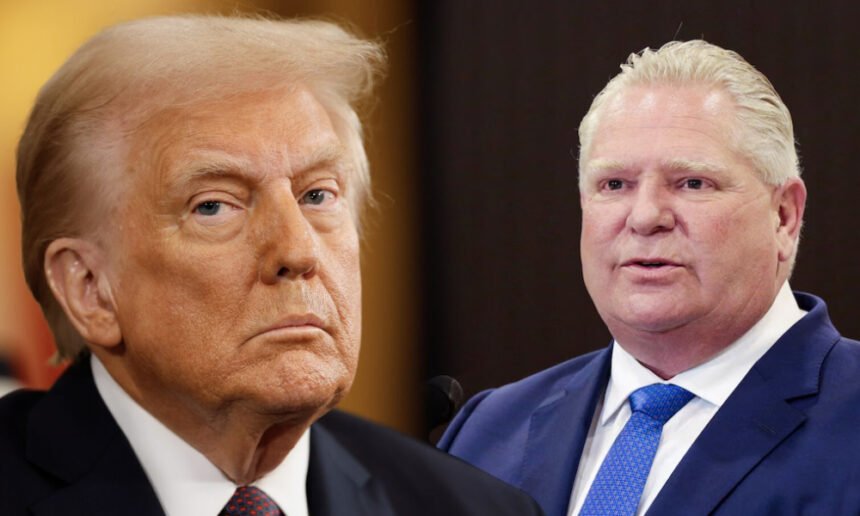
Ontario Premier Doug Ford has a message for Donald Trump: Canada isn’t backing down.
In an interview with The Associated Press, Ford said Canada should be prepared to use some of its most valuable resources as leverage if Trump’s escalating trade war gets worse — including electricity and critical minerals that the United States relies on.
“He underestimates Canada. We’re all in,” Ford said.
And according to Ford, Canadians are ready to absorb some economic pain rather than surrender to Trump’s demands.
“Up here, we’re at a fever pitch, everyone’s in for an economic war. They know they’re going to have to sacrifice.”
That’s a striking escalation from the leader of Canada’s most populous province.
Ford has previously warned that Ontario could cut off electricity exports to the United States almost instantly. Now he’s saying critical minerals, oil and potash could also become bargaining chips.
In other words: if Trump wants a trade war, Canada is preparing to fight back with the things America needs.
## “He declared war”
Ford didn’t mince words when describing Trump’s trade policies.
He said Trump has effectively “declared war, economic war against his closest friend and ally.”
And Ford wasn’t finished.
He brought Ronald Reagan into the fight.
Trump keeps a portrait of Reagan near his desk, but Ford argued that the former Republican president would be horrified by Trump’s protectionist trade policies.
Reagan was a strong advocate of free trade and repeatedly warned about the dangers of tariffs and retaliation.
“He’d be throwing up on him from the picture if he knew what was going on, spinning around in his grave right now,” Ford said.
Ford went on to suggest Trump should take Reagan’s picture off the wall.
“Because right now, Ronald Reagan would be disgusted with President Trump.”
That’s a remarkable attack coming from the leader of a major Canadian province — and one that echoes a fight Ford has already had with Trump over trade.
## Canada walks away, Trump escalates
Ford’s comments came after Canadian Prime Minister Mark Carney walked away from trade negotiations with the Trump administration late Friday.
Carney said Washington was demanding too much in exchange for tariff relief.
The United States then imposed 50% tariffs on roughly $20 billion worth of Canadian goods, while Carney announced dollar-for-dollar retaliation beginning September 8.
Trump escalated the confrontation again Monday, threatening a 50% tariff on Canadian automobiles, auto parts and steel beginning next year.
“Canada has been ripping off the United States of America for years,” Trump wrote on social media.
He also complained about what he called Canada’s “ridiculously high tariffs” on American farmers.
“Not sustainable, and NOT ANYMORE!” Trump declared.
Ford’s response was essentially: bring it on.
Ford said “everything is on the table” if the dispute gets worse. That includes electricity.
It also includes critical minerals that are increasingly important to American manufacturing and national security.
“I’ll cut them off,” Ford said of critical minerals.
“You won’t get a grain of sand out of Ontario.”
Ford specifically pointed to high-grade nickel shipped to the United States and uranium refined in Ontario.
“What would they do without the high-grade nickel that we ship down to the U.S.?” he asked.
That’s not an insignificant question.
Critical minerals are used in everything from electronics to military equipment, including aircraft, missiles and munitions. The United States has been trying to secure more reliable supplies and reduce its dependence on China.
Ford also suggested Canada could use oil and potash as additional leverage.
And then there’s electricity.
Ontario supplies power to 1.5 million homes and businesses in the United States, according to Ford.
“Everything’s on the table. I’ll do whatever it takes,” he said.
Ford has used electricity as a weapon in the trade fight before.
During an earlier escalation, Ontario imposed a 25% surcharge on electricity exported to Michigan, Minnesota and New York.
Trump responded by threatening to double tariffs on Canadian steel and aluminum.
Eventually, both sides backed away.
This time, Ford sounds far less interested in backing down.
“If Trump continues trying to dismantle Canadian manufacturing,” Ford warned, “he better have a pack of batteries.”
The auto industry may be the biggest battleground of all.
Ontario is the heart of Canada’s vehicle manufacturing industry, with major plants operated by Ford, General Motors and Stellantis.
The supply chain is deeply integrated with the United States. Auto parts routinely cross the border multiple times before a vehicle is completed.
That means a major tariff fight could hit manufacturers and workers on both sides of the border.
Ford believes that’s exactly what Trump wants.
He accused the president of trying to hollow out Canadian industries and move production south.
“He wants to bleed out every single sector and bring them down to the U.S.,” Ford said.
Ford went even further, accusing Trump of wanting to turn Canada into a “vassal state.”
The Trump administration sees it differently.
U.S. Trade Representative Jamieson Greer argued Monday that Canada’s auto industry exists in large part because of the 1960s Auto Pact, which used access to Canada’s market to encourage vehicle production north of the border.
Ford isn’t buying it.
“If he thinks the Canadian people are going to roll over and just continue buying American-made vehicles, it’s not going to happen,” he said.
## Ford says he was ready to blow up the deal
Ford also revealed that he opposed a preliminary agreement that Canadian negotiators were considering before Carney walked away from the talks.
“I wasn’t supporting the deal,” Ford said.
One sticking point was American liquor.
Ford said he wasn’t willing to put American alcohol back on Ontario store shelves as part of a trade agreement.
“I wasn’t going to put the booze back on the shelves,” he said. “I was ready to go out there and call a press conference … and say I’m not buckling over.”
But the bigger issue was sovereignty.
According to Ford, Washington sought language that would have restricted Canada’s ability to negotiate trade agreements with other countries without U.S. approval.
Carney has called that demand unacceptable.
Ford’s response was blunt: “Who does he think he is? You gotta be kidding.”
Ford’s latest comments also revive an earlier battle with Trump.
Last year, Ontario paid for television advertisements in the United States featuring excerpts from a 1987 Reagan speech warning about tariffs, retaliation and trade wars.
Trump accused Ford of misrepresenting Reagan and abruptly ended trade negotiations with Canada.
Ford eventually agreed to pause the advertising campaign so negotiations could resume.
Now Ford is once again invoking Reagan against Trump.
“He doesn’t respect anyone,” Ford said.
And yet, despite all the escalating rhetoric, Ford says he doesn’t want the two countries to stop talking.
“I never believe in walking away from the table,” he said.
“Continue negotiating and see where we go.”
That’s the strange reality of this increasingly ugly trade war.
Canada is threatening to cut off electricity, critical minerals and other resources.
Trump is threatening massive tariffs on Canadian industries.
For Ford, that’s apparently where the line is: Canada is willing to fight — but it’s still willing to talk.