







What was supposed to be a three-day backcountry ski trip in the Sierra Nevada ended in unimaginable tragedy.
Eight skiers are dead and one remains missing — and presumed dead — after a massive avalanche tore through the slopes near Castle Peak, just outside Lake Tahoe, authorities confirmed Wednesday. Officials say it is the deadliest avalanche in California’s recorded history.
Nevada County Sheriff Shannan Moon delivered the grim update at a somber press conference.
“Our mission has went from a rescue to a recovery,” Moon said, adding that families of the missing had been notified.
According to ABC-7 News, the 15-person group — made up of 11 clients and four guides — was on the final leg of its trip Tuesday morning when a wave of snow, ice, and debris the length of a football field came crashing down.
The avalanche struck Castle Peak, a 9,110-foot backcountry destination near Donner Summit. According to Tahoe National Forest Supervisor Chris Feutrier, the slide was triggered by a “persistent weak layer” buried beneath heavy new snowfall — a deadly setup that had already been flagged by avalanche forecasters.
That weak layer? It’s still there. And it has since been buried under another three feet of snow.
Translation: The danger isn’t over.
High Risk — and a Warning in Place
The Sierra Avalanche Center had rated the avalanche threat at 4 out of 5 — the second-highest danger level — and had upgraded an avalanche watch to a warning hours before the disaster.
The National Weather Service warned that natural avalanches were “likely,” and that human-triggered slides large enough to bury people were “very likely.” Travel in backcountry avalanche terrain was not recommended.
Still, the group proceeded, Los Angeles Times reports.
Blackbird Mountain Guides, the company leading the trip, had even posted on social media days earlier about unstable snow conditions, warning that “avalanches could behave abnormally.”
Whether the guides were aware of the upgraded warning before heading out remains unclear.
A Brutal Rescue Effort
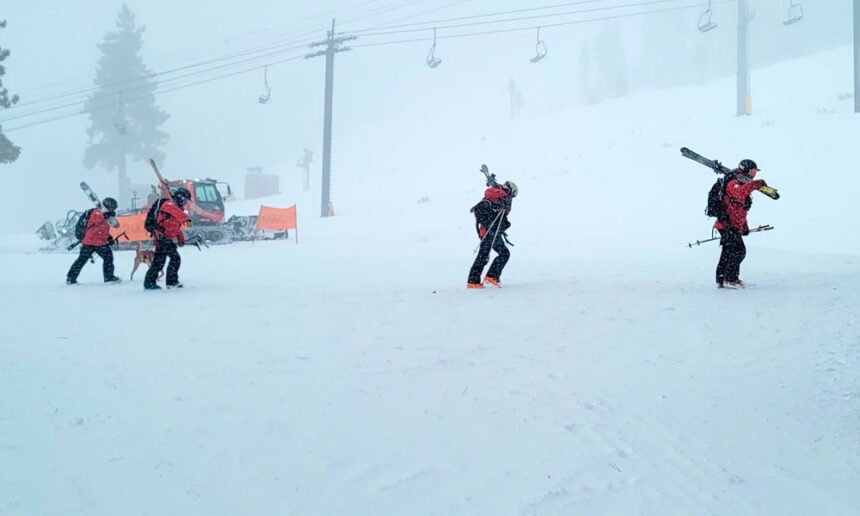
Emergency crews received the first distress call around 11:30 a.m. Tuesday. Roughly 50 rescuers deployed into whiteout conditions, battling heavy snowfall and high winds.
Survivors — four men and two women — were buried but managed to send SOS signals through emergency beacons and iPhone satellite features. Some were in communication with rescuers for hours.
They built a makeshift shelter from a tarp and did what they could to stay alive.
It took 11 hours to rescue the six survivors. But nine others remained buried. Eight have since been recovered deceased. One is still missing.
Officials said the victims’ bodies were found “fairly close together.” Seven of the nine unrescued skiers were women. Two were men. Their names have not yet been released.
A Community in Shock
Among the victims was the spouse of a member of Tahoe Nordic Search and Rescue — a loss that has devastated the tight-knit mountain community.
“This has not only been challenging for our community… it’s been challenging emotionally for our team and our organization,” said Placer County Sheriff Wayne Woo.
California Gov. Gavin Newsom called the avalanche a “horrible tragedy.”
“We mourn this profound loss,” he wrote.
Avalanche Survival Is a Race Against Time
Avalanche survival rates drop fast. According to data from the Utah Avalanche Center, 93% of buried victims survive if rescued within 15 minutes. After 45 minutes, survival drops to as low as 20%. After two hours, the odds are grim.
Backcountry skiers face the highest number of avalanche fatalities nationwide, according to the Colorado Avalanche Information Center.
Castle Peak has seen deadly slides before. In January, a snowmobiler was killed in an avalanche in the same area — despite carrying protective gear and avalanche beacons.
But nothing in California’s modern record compares to this week’s catastrophe.
Authorities are still reviewing the decision-making that led the group into high-risk terrain under active avalanche warnings.