









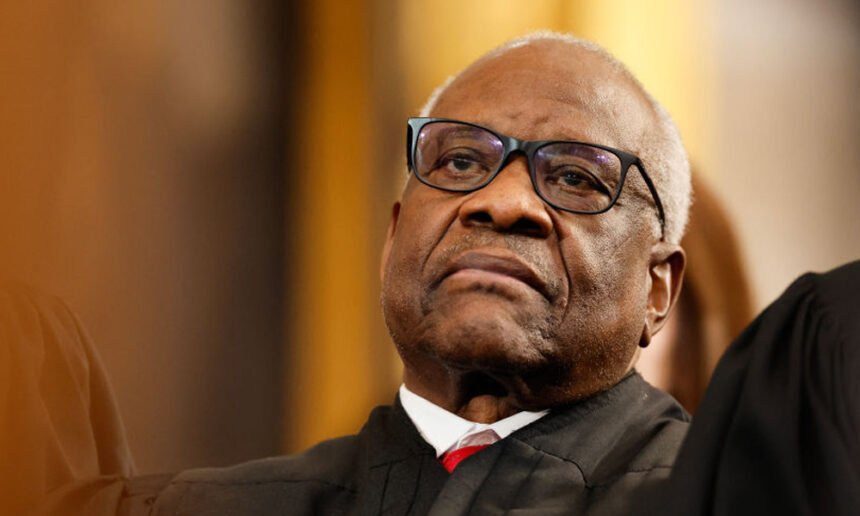
The Justice Department’s massive Friday dump of roughly 3.5 million Jeffrey Epstein–related documents has done what these releases always do: ignite outrage, raise brutal questions, and leave the public with no clear answers. Buried inside the flood of paperwork is a stunning allegation naming Supreme Court Justice Clarence Thomas, revealed in an email reviewed and discussed by federal prosecutors in New York.
The accusation surfaced in an email sent to the U.S. Attorney’s Office for the Southern District of New York and addressed to two federal judges. According to the DOJ files cited by Raw Story, a person claiming to be an Epstein victim accused Johnny Martorano, a longtime mob hitman who has admitted to killing 20 people, of rape. Martorano, who cut a plea deal in 1999 that landed him just 12 years in prison, was also alleged to have been in communication with Thomas.
“John Martorano was the man who raped me and took a picture of me naked and said ‘let’s take a picture for Clarence Thomas,’” the individual wrote.
The email didn’t stop there. It went on to accuse Thomas himself of sexually assaulting the accuser when she was a child. “This is also in my CIA file because a few people have asked me if I remembered, but I couldn’t remember much of my childhood because I was drugged so much,” the message read.
There is no evidence provided in the documents to substantiate the claims, and the DOJ release makes clear that many of the materials include unverified and uncorroborated allegations that do not amount to evidence. Thomas is not facing any criminal charges or investigations related to the accusation.
Still, the paper trail alone is explosive.
The email containing the allegation was forwarded in August by federal prosecutor Robert Sobelman to Kristen Warden, who according to her LinkedIn profile works at the U.S. Securities and Exchange Commission and previously served in the Justice Department’s Office of the Inspector General.
“Kristen, pursuant to the standard protocol in this case, please see below and attached,” Sobelman wrote in an Aug. 12 email, attaching the accuser’s lengthy statement.
Warden’s response came quickly — and raised more questions than it answered.
“Is this the same complainant from the guardians you were drafting?” she asked, indicating the accuser was already known to her or her office.
“Yes, it’s from the same complainant,” Sobelman replied later that afternoon, according to Raw Story.
That exchange alone underscores the unsettling reality of the Epstein files: allegations this severe were circulating within federal offices, quietly forwarded and acknowledged, while the public remained in the dark. Now, years later, they surface without resolution, without proof, and without accountability.
As with so much of the Epstein saga, the Clarence Thomas allegation lands in a gray zone — officially unproven, legally dormant, and politically radioactive. What it undeniably does is reinforce a growing belief that when scandals touch the powerful, they don’t end. They just get buried.