






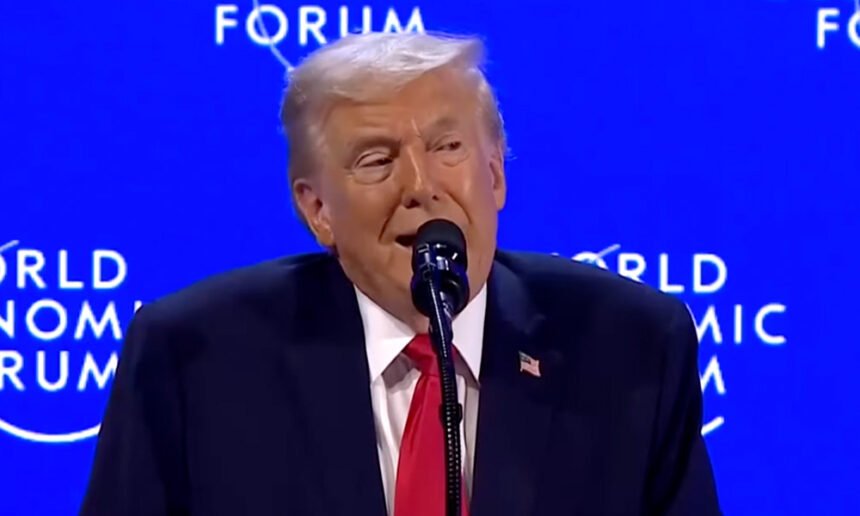
At the World Economic Forum in Davos, President Donald Trump once again dragged the United States into yet another foreign policy dumpster fire as he insists the U.S. should control Greenland, the semi-autonomous Danish territory. In a speech that undercut every claim of diplomatic restraint, Trump doubled down on his obsession with owning a huge chunk of northern real estate, sparked outrage among European allies, and managed to confuse the territory with Iceland more than once on the world stage.
Trump spent a large portion of his Davos address insisting the United States is uniquely qualified to “secure” Greenland — despite it being part of NATO and fully under Danish sovereignty — and bristled when European partners balked at the idea. The president even dismissed Denmark’s firm resistance as “ungrateful” while labeling his demand a “small ask” over what he repeatedly called a “piece of ice.”
Trump was explicit that the U.S. wouldn’t resort to military force — a notable shift from earlier rhetoric — but his refusal to drop the subject has turned what should have been a routine economic forum speech into a transatlantic crisis.
His insistence that the U.S. should control Greenland hasn’t just rankled allies; it’s strained NATO’s cohesion. European diplomats have privately expressed alarm at the idea of a sitting U.S. president dictating terms over a fellow member’s territory. Some delegates lost interest in Trump’s broader economic points as he veered in and out of the Greenland dispute, muddled by references that confused it with its neighboring island, Iceland.
The reception wasn’t just cold — it was icy. Denmark has repeatedly stated Greenland isn’t for sale, and both Danish and Greenlandic leaders have condemned Trump’s overtures as disrespectful to their sovereignty. Massive protests under the slogan “Greenland is not for sale” erupted in Copenhagen and Nuuk earlier this month, representing the largest anti-Trump demonstrations in Greenland’s history.
Meanwhile, other NATO capitals are quietly reevaluating how to deal with a U.S. leader who equates diplomatic leverage with territorial claims. Officials in France, Germany, and elsewhere have warned that such blunt pressure tactics could have serious consequences for cooperation on everything from defense to trade.
Trump’s Greenland gambit has become more than a talking point — it’s a flashpoint. On a platform meant to showcase global economic cooperation, he instead thrust the U.S. into a messy debate about sovereignty, alliance obligations, and rhetorical blunders that reverberate far beyond the Swiss ski slopes.
Watch the clip below: