




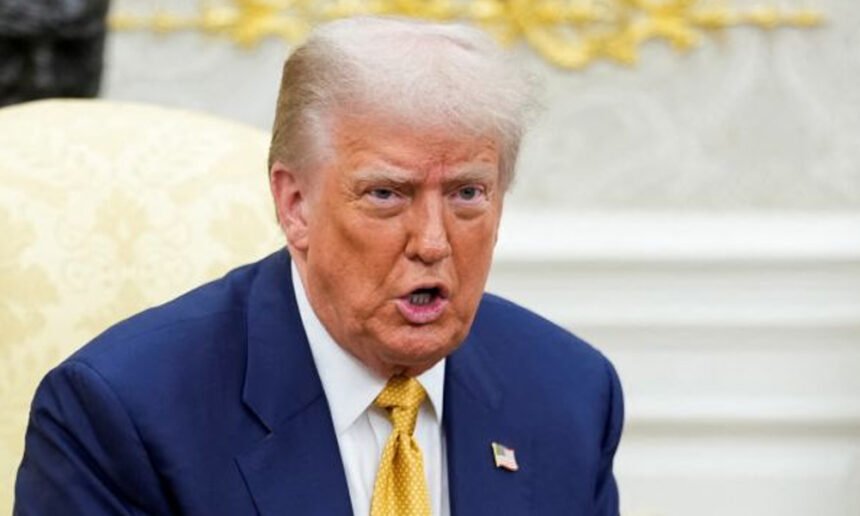
President Donald Trump is threatening more U.S. military action in Nigeria unless what he calls “violent persecution of Christians” stops, and he’s doubling down on the Christian-versus-Muslim framing that’s already inflamed diplomatic lines.
In an interview published this week with The New York Times, Trump said the U.S. could carry out additional strikes in Nigeria “if they continue to kill Christians.” He referenced a Christmas Day attack carried out by U.S. forces against Islamic State-linked militants in northwest Nigeria and cast it as the first step in a sustained campaign unless what he sees as targeted violence against Christians stops, Reuters reports.
“I’d love to make it a one-time strike … But if they continue to kill Christians, it will be a many-time strike,” Trump told the paper. When challenged with reporting from his own Africa adviser that Islamist militant groups were killing more Muslims than Christians, Trump answered, “I think that Muslims are being killed also in Nigeria. But it’s mostly Christians.”
Trump’s comments mark the latest twist in a growing diplomatic standoff between Washington and Abuja over how to characterize the deadly violence that has long plagued parts of Nigeria — violence largely driven by Islamist insurgents, bandits, and militias that do not exclusively target Christians.
The U.S. military strike on Dec. 25, which Trump framed as an assault on groups committing atrocities against Christians, was described by Nigeria’s foreign ministry as a joint operation targeting terrorists, and not tied to any particular religion. Abuja has repeatedly said that Islamist extremist groups kill both Christians and Muslims and that the violence cannot be reduced to a simple religious persecution narrative.
Trump’s rhetoric has also included broader threats. In October and November, he warned that he would halt all U.S. aid to Nigeria and ordered the Pentagon to prepare for possible action if the Nigerian government did not curb attacks on Christian communities — language that Nigerian officials pushed back on as misrepresenting the country’s security situation.
Even within Nigeria, reactions are mixed. Some religious leaders welcomed assistance against militant groups, while others have argued that framing the conflict as purely religious violence oversimplifies a complex, multi-layered security crisis. Independent analysts and clerics have emphasized that no single religious group is exclusively targeted and that the violence stems from governance failures, economic disparities, and entrenched insurgency struggles.
Nigeria, a nation nearly evenly split between Christians in the south and Muslims in the north, has seen decades of violent conflict fueled by groups like Boko Haram and Islamic State affiliates. These groups have attacked communities, security forces, and civilian populations across the country, often without regard to religious identity.
Trump’s comments come as Nigeria’s government has pledged to strengthen its own armed forces’ capabilities to counter insecurity. Abuja has also signaled willingness to coordinate with the U.S. militarily while firmly rejecting the idea that Nigerian authorities condone or encourage religious persecution.