


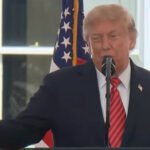
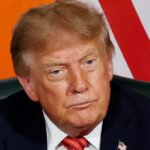


President Donald Trump has warned Iran that the United States is “locked and loaded” and ready to intervene if Tehran violently suppresses protests.
“Locked and Loaded” Without a Plan
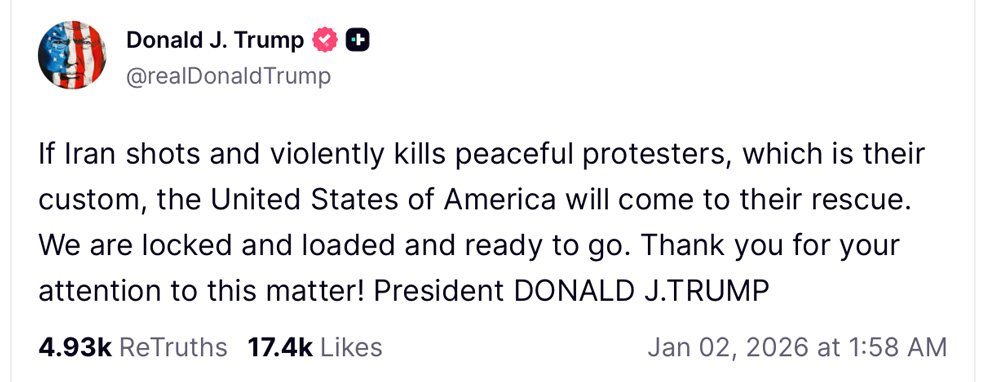
On Friday, Trump posted on Truth Social that if Iran “shots and violently kills peaceful protesters,” the United States would come to their rescue, adding “We are locked and loaded and ready to go.”
He didn’t outline specific support mechanisms, define what “rescue” means, or present any plan that doesn’t sound drawn from a Cold War action movie script. It’s the kind of language that can stoke escalation without clarity on consequences.
Trump’s pronouncement wasn’t aid for protesters, critics say. It’s an escalation strategy — a geopolitical bet that the U.S. can leverage unrest abroad for domestic political gain.
The Protests Are Real — But They’re Not a U.S. Proxy Army
The unrest in Iran is not some U.S.-orchestrated rebellion. It started from economic collapse, a collapsing rial, skyrocketing prices, and widespread public frustration — shopkeepers first, then students, then regular citizens in cities from Tehran to Shiraz.
The current wave of demonstrations is the largest since the 2022 protests sparked by the death of Mahsa Amini under state custody. People are rising because they’re fed up with inflation, declining living standards, and a governance model that has delivered decades of economic misery alongside authoritarian repression.
Trump’s framing — that Tehran’s response will determine whether the U.S. leaps in — twists that organic discontent into a U.S. intervention narrative that suits hawkish domestic audiences but ignores the protests’ internal roots.
Iran Won’t Let This Go Quietly
Beijing and Moscow aren’t the only ones watching this exchange. Iran’s leadership reacted sharply. Officials said any U.S. interference would cross a “red line” and could destabilize the region — a warning that echoed beyond Tehran’s halls of power.
This matters because Trump’s threat doesn’t exist in a vacuum. It comes on top of years of fraught U.S.–Iran relations, heightened after the U.S. withdrew from the 2015 nuclear deal in 2018 and conducted military operations inside Iranian territory during the last year’s regional conflict.
Trump’s stance here isn’t a benign nod to human rights. It’s geopolitical posture — and it’s risky.
The Political Logic Here Is Domestic, Not Strategic
Let’s be blunt: this isn’t purely about Iranian civilians. Trump is speaking to Americans — voters and donors — who respond to muscular foreign policy talk and pledges to “stand up to the regime.” That’s politics masquerading as principle.
There’s a pattern: strong words without commitments that can be measured or verified. No articulation of diplomatic channels. No plan for sanctions relief if Iran refrains from violence. No multilateral coordination with allies. Just a wild post promising intervention if Tehran misbehaves.
Inserting vague U.S. intervention threats into that mix isn’t cautious policymaking. It’s irresponsible brinkmanship — the sort that could draw the U.S. deeper into a confrontation no one is asking for.
Trump’s pronouncement wasn’t support for human rights. It was an escalation gambit dressed as solidarity. And that’s exactly how Iran’s leaders are treating it.