



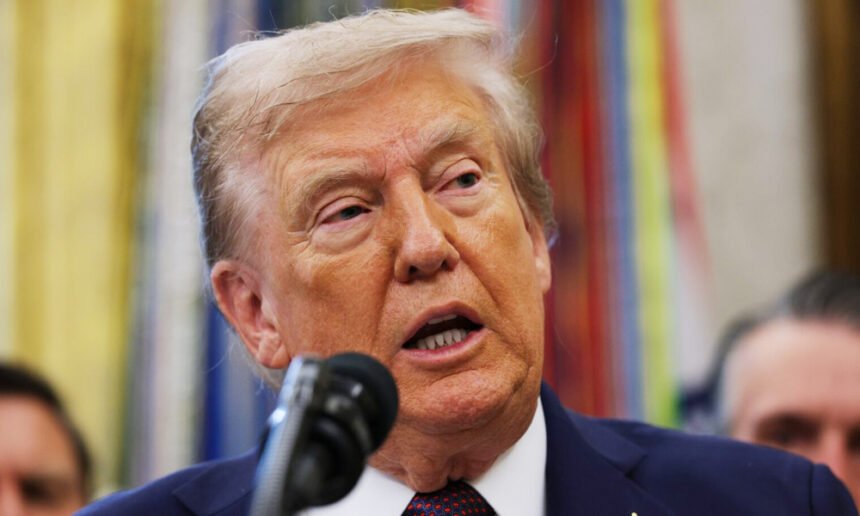
President Donald Trump has now taken his toughest public line yet on Venezuela, telling airlines to treat the country’s skies as fully off-limits and signaling that the U.S. military campaign that has already turned deadly at sea could soon expand to land.
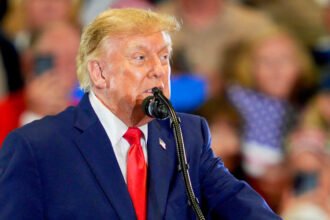
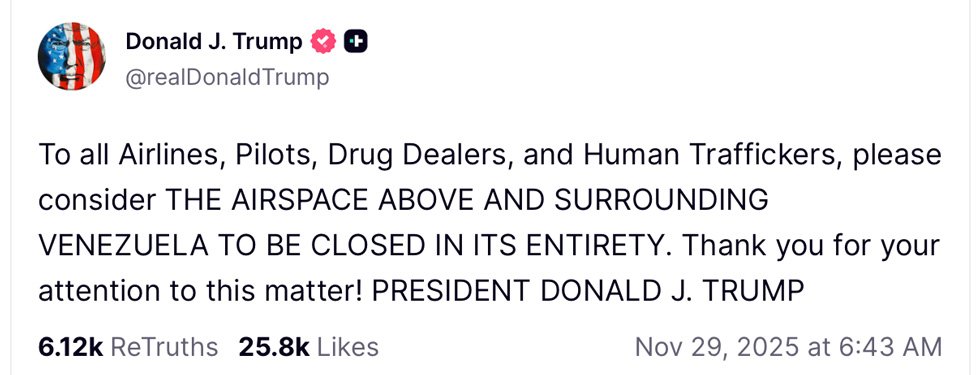
The warning came Saturday morning, blasted out on Truth Social in Trump’s unmistakable cadence: “To all Airlines, Pilots, Drug Dealers, and Human Traffickers, please consider THE AIRSPACE ABOVE AND SURROUNDING VENEZUELA TO BE CLOSED IN ITS ENTIRETY.” It capped a tense week in which Trump told U.S. troops that land operations would begin “very soon,” following dozens of deadly strikes on alleged drug-running boats in the Caribbean and Pacific.
Those maritime strikes have already killed more than 80 people since September, a staggering figure that the administration frames as part of a wider effort against what it calls “narco-terrorists” tied to Venezuelan President Nicolás Maduro. Defense Secretary Pete Hegseth has aggressively defended the campaign, saying the operations are “lawful under both U.S. and international law” and insisting that “every trafficker we kill is affiliated with a Designated Terrorist Organization.”
The Federal Aviation Administration quickly echoed Trump’s escalation with its own alert, telling airlines to “exercise caution” when flying over Venezuela “due to the worsening security situation and heightened military activity.” Several carriers didn’t wait for further clarification and canceled flights outright.
Behind the scenes, the White House has been eyeing even more unconventional tactics. According to the Washington Post, officials discussed dropping leaflets over Caracas advertising the U.S. government’s $50 million reward for information leading to Maduro’s arrest or conviction. The reward was first offered in 2020, but the Trump administration raised it this year as part of its increasingly open push to remove Maduro from power.
The administration’s posture marks a return to a pressure campaign that began years ago but now carries far more kinetic force. The State Department recently designated Cartel de los Soles—a group it says is run by Maduro and senior figures in his “illegitimate” regime—as a “Foreign Terrorist Organization.” Trump claims the U.S. is locked in an “armed conflict” with drug cartels he alleges are backed by Maduro’s government.
Yet, even amid this hardline shift, the diplomatic picture is strange. Just days before Maduro was branded the leader of a foreign terrorist organization, Trump and Maduro spoke by phone and discussed meeting, according to The New York Times. And Axios reports Trump is planning to speak with him again.
Still, Trump’s tone with the military has only sharpened. On his Thanksgiving Day call to service members, he said, “In recent weeks, you’ve been working to deter Venezuelan drug traffickers, of which there are many. Of course, there aren’t too many coming in by sea anymore.” He then added, “You probably noticed that people aren’t wanting to be delivering by sea, and we’ll be starting to stop them by land also. The land is easier, but that’s going to start very soon. We warn them: Stop sending poison to our country.”
Hegseth, for his part, has portrayed the mission as both moral and necessary. “The declared intent is to stop lethal drugs, destroy narco-boats, and kill the narco-terrorists who are poisoning the American people,” he wrote Friday. “The Trump administration has sealed the border and gone on offense against narco-terrorists. Biden coddled terrorists, we kill them.”
But questions about legality and oversight are piling up. Legal scholars, former national security officials, and members of Congress have warned that the president may be claiming sweeping authority to kill suspected traffickers without judicial process. Hegseth maintains everything is above board: “Our current operations in the Caribbean are lawful under both U.S. and international law, with all actions in compliance with the law of armed conflict—and approved by the best military and civilian lawyers, up and down the chain of command.”
That confidence doesn’t line up neatly with disturbing reporting about the first of these strikes in September. The Washington Post revealed that Hegseth had delivered a verbal order to leave no survivors. When two people emerged alive after the initial hit, a Special Operations commander allegedly ordered a second strike to carry out Hegseth’s directive to “kill everybody.”
Trump’s latest move—declaring Venezuela’s airspace effectively shut down—pushes the standoff into even more volatile territory. Airline executives are rattled. Regional governments are bracing for spillover. And Venezuelans, already battered by years of political and economic collapse, now face the possibility of U.S. military action edging closer not just to their borders, but to their cities.