







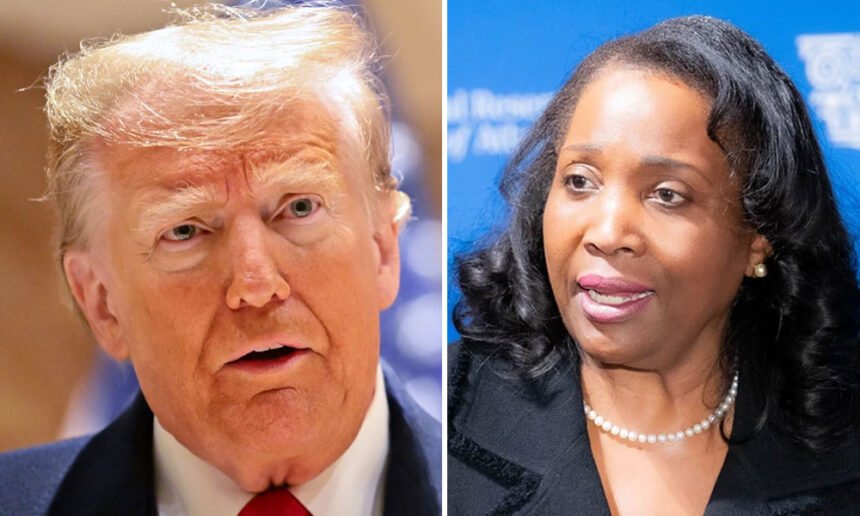
In a significant blow to President Donald Trump’s attempt to reshape the Federal Reserve, a federal appeals court ruled Monday that he cannot remove Governor Lisa Cook from her post.
The emergency ruling, handed down just hours before the Fed kicked off its two-day monetary policy meeting, came from the U.S. Court of Appeals for the District of Columbia Circuit. The decision, split 2-1 along party lines, temporarily blocks Trump’s attempt to fire Cook over unproven allegations of mortgage fraud — allegations for which she has not been charged with any wrongdoing.
“In this court, the government does not dispute that it failed to provide Cook even minimal process—that is, notice of the allegation against her and a meaningful opportunity to respond—before she was purportedly removed,” Judges Bradley Garcia and Michelle Childs wrote in the majority opinion.
They continued: “The district court issued its preliminary injunction after finding that Cook is likely to succeed on two of her claims: her substantive, statutory claim that she was removed without ‘cause’… and her procedural claim that she did not receive sufficient process prior to her removal in violation of the Due Process Clause of the Fifth Amendment.”
Judge Gregory Katsas dissented, arguing that “President Trump removed Cook for cause.”
The ruling essentially leaves Cook in place just as the Fed faces critical decisions on interest rates, with markets expecting a potential rate cut. But beyond the timing, the decision puts a spotlight on something bigger: the independence of the Federal Reserve, and the lengths to which Trump may go to bend it to his political will.
Cook, a Biden appointee and the first Black woman to serve on the Fed’s Board of Governors, sued Trump after he claimed to have fired her, calling the move a violation of her due process rights and accusing him of relying on “an unsubstantiated allegation.”
If Trump eventually succeeds in removing her, it would be a first — no president in the Fed’s 111-year history has ever fired a sitting board member.
At the same time Trump tried to oust Cook, the Senate confirmed Stephen Miran, his nominee to fill a different seat on the Board. It’s a clear sign that Trump isn’t just trying to influence the Fed — he’s actively stacking it.
Cook’s legal team was blunt in their warning to the court: “President Trump’s attempted removal of Governor Lisa Cook, if allowed, would mark an immediate end to that history.” That history being the Fed’s longstanding independence from direct political interference.
Trump’s allies argue otherwise, calling Cook’s lawsuit “meritless” and painting her as untrustworthy. The administration claims her alleged financial misstatements — again, never charged — raise doubts about her ability “to act with forthrightness, care, and disinterest in managing the U.S. money supply.”
But for many economists, the real concern isn’t Cook’s integrity — it’s the precedent Trump is trying to set. “President Trump does not have the power to unilaterally redefine ‘cause’ – completely unmoored to caselaw, history, and tradition – and conclude, without evidence, that he has found it,” her attorneys wrote.
In short, Trump is trying to stretch the legal definition of “for cause” to mean “for disagreeing with me.”
That’s not how the Fed was designed to work. The central bank’s structure was meant to keep it independent from political pressure, so it could focus on its actual job — balancing inflation and employment — not winning elections.
That hasn’t stopped Trump from trying. He’s spent years publicly berating Fed Chair Jerome Powell, calling him a “numbskull,” “a very stupid person,” and “a major loser” for not slashing rates fast enough. He even threatened to fire him, before walking that back and saying he’d let Powell finish his term through May.
And the timing here is hard to ignore. Trump’s effort to remove Cook comes right as he ramps up pressure on the Fed to lower interest rates — a move that could boost the stock market, cheapen loans, and juice the economy ahead of the election.
But the Fed doesn’t exist to juice elections.
Whether Trump ultimately succeeds in removing Cook is now in the hands of the courts. But Monday’s ruling sends a clear message: even presidents — especially ones with an agenda — can’t just bulldoze independent institutions.
Not without a fight.